
Video: UPS puts autonomous trucks on the road
Logistics giant UPS is testing self-driving trucks as part of a minority investment in autonomous driving company TuSimple.
Together, the companies are testing self-driving truck and trailer units in Arizona to determine whether the vehicles can improve service and efficiency in the freight network.
The partnership began with the goal of helping UPS better understand the requirements for Level 4 autonomous trucking.
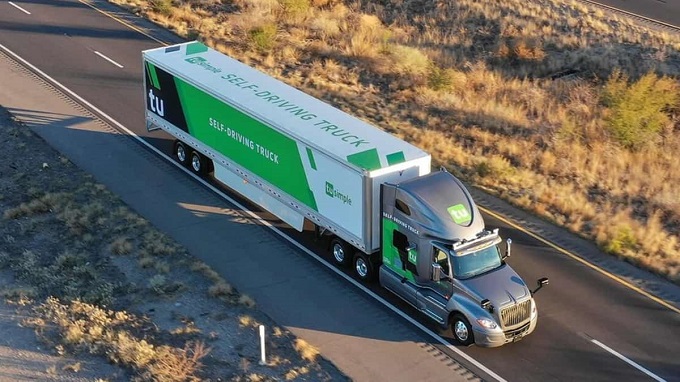
Level 4 autonomous means the vehicle’s onboard computer is in complete control at all times, removing all manual intervention.
However, laws regulating this level of autonomous driving currently require a driver in the vehicle at all times to take over operation if needed.
Throughout the tests, UPS has been providing goods for TuSimple to carry on a North American freight forwarding route between Phoenix and Tucson, Arizona.
The company initiated self-driving service in May, 2019, with a driver and engineer in the vehicle. TuSimple and UPS monitor distance and time the trucks travel autonomously, safety data and transport time.
UPS chief strategy and transformation officer Scott Price says the company “is committed to developing and deploying technologies that enable us to operate our global logistics network more efficiently”.
“While fully autonomous, driverless vehicles still have development and regulatory work ahead, we are excited by the advances in braking and other technologies that companies like TuSimple are mastering. All of these technologies offer significant safety and other benefits that will be realised long before the full vision of autonomous vehicles is brought to fruition – and UPS will be there, as a leader implementing these new technologies in our fleet.”
Founded in 2015, TuSimple’s mission is to bring the first self-driving truck to market, to increase safety, decrease transportation costs and reduce carbon emissions.
UPS contracts with third-party trucking companies during its peak shipping season. TuSimple believes it could cut average purchased transportation costs by 30%.
TuSimple founder, president and chief technology officer Xiaodi Hou says he is “honored by UPS’s strategic investment and their vote of confidence in TuSimple”
It “proves their commitment to staying at the forefront of innovation … TuSimple is confident that it can accelerate bringing the first self-driving truck to market to increase road safety,” he says.
UPS’s tests with TuSimple are part of an advanced technology evaluation for vehicles in the UPS Global Smart Logistics Network.
UPS is investing in internet of things (IoT) technology, artificial intelligence (AI) and advanced analytics to increase fuel efficiency and improve customer service to ensure that UPS remains the shipper of choice.
One way UPS explores new technologies is via its internal venture capital group UPS Ventures, which was established in 1997 as the UPS Strategic Enterprise Fund (SEF).
In 2018, the SEF refined its objective and took the new name UPS Ventures. The group takes a minority stake in technology start-ups and actively partners with companies to achieve technology goals for the UPS Smart Logistics Network.
UPS Ventures managing partner Todd Lewis says the “mission is to build collaborative relationships with early-stage companies that provide capabilities and insights that accelerate technological advancements within our network”.
“UPS Ventures collaborates with start-ups to explore new technologies and tailor them to help meet our specific needs,” he says.

Join the conversation