
Women driving change

This story first appeared in the October issue of EvTalk – CLICK HERE to download the magazine FREE
Victoria Carter is a driver of change.
After a varied career (she has a law degree and has worked in marketing, public relations and politics) which included service on the boards of Turner’s Auctions and Jucy Group, Carter holds to a “sustainable driving” belief after co-founding car sharing service Cityhop.
Although no longer serving on Cityhop (son Ben Carter is general manager), she never misses an opportunity to promote it and car sharing generally, saying it’s good for cities and the planet.
Carter points to car sharing reducing car ownership globally, adding that each Cityhop car replaces nine to 15 privately owned vehicles which sit in carparks nearly 90% of the time, allowing space to be reclaimed for other transport modes.
She doesn’t own a car – using Cityhop instead, often a Volkswagen e-Golf.
Cityhop introduced 25 new EVs to its fleet of more than 200 cars, about a quarter of them now hybrids or full EVs.
A key to car sharing, where you rent vehicles by the hour, is to change people’s mindsets around car ownership, Carter says.
About 53% of Cityhop members delayed their next car purchase, sold their car or live without one.
Many also use different transport forms, perhaps biking, scootering or using public transport.
“The average driver does about 8000km a year, but once there’s no car in their garage they do much less, even about half that,” Carter says.
Cityhop reckons its members drive about 2000km less every year.
Rates vary according to the vehicle, ranging from about $9.50 an hour to an e-Golf costing $15 an hour plus kilometres.
Cityhop rates include parking, fuel, insurance, maintenance and cleaning.
That works out much cheaper than car ownership, Carter says.
Many small businesses who drop off supplies once a week should look at vehicle sharing rather than owning a van, she adds.
Child seats and dog “hammocks” (stopping dog hair spreading around the car) are available too.
Cityhop cars all have names, and Carter has a Toyota Prius hybrid called “Vicky” named after her.
On her travels, Carter has seen car sharing work well in some other major cities, and she says Cityhop members’ behavioural changes have resulted in more than a million kilograms of carbon dioxide savings each year.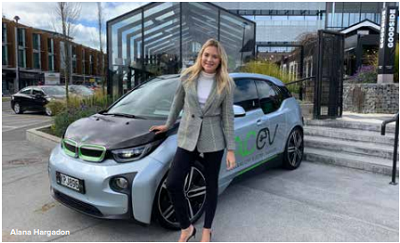
Sustainability and climate change are close to Carter’s heart, so she welcomes anything that can be done in transport to assist.
Recognised for her work, Carter was appointed an Officer of the New Zealand Order of Merit in 2016 for services to art, business and the community.
And transport minister Phil Twyford recently announced Carter as one of the new directors on the NZ Transport Agency Board.
Alana Hargadon is Auckland City Electric Vehicles (ACEV) office manager in Takapuna, Auckland, a family run business with husband Hadley, who has been involved in the automotive business most of his career.
Her job involves everything from marketing and social media to assisting with vehicle buying from Japan.
“The biggest highlight has been seeing our loyal customers follow us to our beautiful new 900sqm location, which we opened earlier this year,” she says of the 83 Barry’s Point Road showroom.
A daughter of Allan Clarke, who ran Allan Clarke Motors on the North Shore for many years and who remains closely involved with ACEV, Hargadon has a business degree majoring in marketing and finance.
Working in marketing for several years, she became involved in the fashion industry – those skills useful in the new showroom.
“I’m always following trends, whether cars or fashion, so I have been dressing the new showroom.”
Hargadon says different colours make it look great.
A green growing wall helps and goes with ACEV’s slogan “Switch to an EV today for a greener tomorrow”.
An electric scooter is used for milk runs for coffee for staff and customers.
Hargadon says customer experience means everything to her.
“So, seeing our lovely clients return to us for repeat business is very rewarding”.
The couple got into EVs during a family dinner discussion.
“We could see it was a good decision to import electric vehicles and we loved the feeling of driving them and making a difference to the environment and thought Aucklanders would too.
“My father Allan has been in the industry since the 1970s and has really enjoyed the transition to electric vehicles.”
Hargadon drives a company BMW i3, charging at work or home.
“I save around $7k a year on fuel and at least $2000 on servicing over my old non-electric BMW,” she says.
EV promotions are among her favourite job aspects.
“We were thrilled to have taken part in the ‘Leading the Charge road trip’ when it stopped in Takapuna, our sales team invited the local community for a spin in our electric vehicles and being a Takapuna local I loved seeing everyone come together to experience an EV for the first time.We are also a member of Drive Electric and will be attending EVworld NZ next year.”
Hargadon says EVs benefit the local community and New Zealand’s future, with more people considering an EV due to rising petrol prices.
“For a lot of customers the number one driver behind their decision is the saving from no longer needing petrol.Followed by the obvious sustainability factors.”
Hargadon believes it’s crucial to work together to raise awareness on climate change and to make the important changes in people’s lives.
She says many customer employers are putting in chargers as an incentive for their employees to go electric.
ACEV encourages people to try an overnight test drive to see if the vehicle fits with their family and lifestyle.
Along with the BMW i3s they sell battery electric vehicles such as the Nissan Leaf (all, including the 40kWh) and Nissan e-NV200 van, along with plug-in hybrids such as the Mitsubishi Outlander and VW Golf GTE.
“The industry is moving so quickly towards being electric only,” Hargadon says.
“All the vehicle manufacturers are increasing EV output.The number releasing new EV-only models is incredible.In the next three to four years it will be very interesting to see the level of EVs on our roads.”

Join the conversation