
Your basic EV guide to charging

Charging your EV is easy.
Just think of it as like charging your smartphone.
Most EV owners charge at home overnight by simply plugging in a cable – usually provided with the car – to a standard wall socket and having the car charge while they sleep.
As one owner says: “I can charge in less than three minutes.
I flick the switch before I go to sleep and it’s done when I wake up.”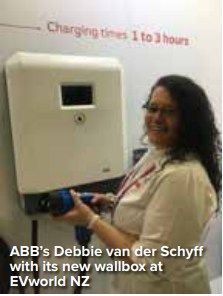
It pays to check the provided cable or any that you buy meet New Zealand standards (it should also come with a signed certificate of compliance).
And, particularly if your home is old, have the wiring checked by an electrician to ensure it can handle the extra load.
A typical New Zealand home is wired for about 15kW of power and most homes have alternating current (AC) mains supply suitable for Type 1 and Type 2 charging, the latter standard for most new EVs here.
Type 1 is usually single phase whereas Type 2 can be single, two-phase or three-phase.
Don’t use an extension cable for charging and don’t adapt an overseas charging cable yourself.
Consider getting surge protection too.
Wall-mounted smart chargers are becoming increasingly available for the home.
These allow faster charging, can provide charging control through your smartphone or a touch panel and provide relevant information, may reduce costs through off-peak selection, and can even work in conjunction with solar power and battery storage.
Check out the cost and whether it’s worth it for you.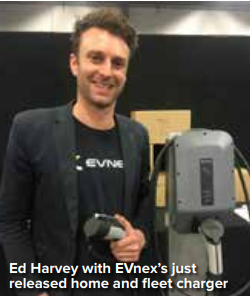
Many wall or pedestal chargers are designed for businesses too, coming with remote software updates, the ability to charge more than one EV at once, provide information on energy use and much more.
Apartment buildings are starting to install EV chargers and some places like Wellington are also trialling street charging for those who don’t have off-street parking.
EV drivers may also be able to charge up at work – especially if their company is switching its vehicle fleet to electric.
Free or paid public charging is available in many areas now, including shopping centres, camping grounds and at key destinations or accommodation sites.
Types of charging in New Zealand include the recommended European style Type 2 outlets (which includes Type 1 as well) whereby EV drivers mainly use their own leads, Tesla superchargers (restricted to Tesla owners), and Chademo DC fast charging – the latter two common overseas.
All DC fast charge stations have tethered cables.
A nationwide pay EV charging network to enable to people to get around the entire country in an EV is supplied by ChargeNet NZ, which recently opened nine more.
Check when buying an EV what the charging type is.
Charging times vary from many hours (like overnight) to an hour or two with charging times coming down and likely to soon be the equivalent of topping up with fossil fuel.
A general guideline on charging an EV is the equivalant of 30c/litre of fossil fuel on average.
Some EV owners combine charging when out and about with stopping for a break or to do shopping (hence charger installations at a growing number of supermarkets and shopping centres).
Many varieties of chargers are becoming available.
You can check out offerings from suppliers in this magazine, including Evnex, YHI (New Zealand), ABB, Jackson Industries, TransNet NZ, Schneider Electric, ChargeSmart, Singer Electrical, and Paul O’Connor’s OEM cables.
EV battery sizes are increasing in many cases, such as the new Nissan Leaf arriving in dealerships from August 16 with a 40kWh battery compared with a 24kWh battery in earlier models (a 64kWh battery version is also available overseas).
Many new EVs have greater driving range with fewer and less time-consuming charging stops.
Charging will change over time.
Tests are already being done on solar power integrated into EVs with solar panels covering much of the trial car’s surface.
Bi-directional charging is also becoming available, new models like the latest Nissan Leaf able to return power to the home or business, especially useful in emergencies.
Trials are being held on various vehicle-to-home (V2H), vehicle-to-grid (V2G) and vehicle-to-everything (V2X) technologies.
With public charging while out and about, there’s also an etiquette involved.
The Better NZ Trust, which promotes EVs, has a code of behaviour which suggests being polite when sharing public chargers, not parking illegally to do so, drivers returning to vehicles when charging is completed so as not to hold up others, only unplugging other EVs if you have permission or when it has finished charging, and to be “nice to ICE” and leave polite notes if a fossil fuel car is blocking charger access.
If you are unsure about any charging aspect, contact the relevant people featured in this magazine for further information.

Join the conversation