
Energy storage’s future investigated
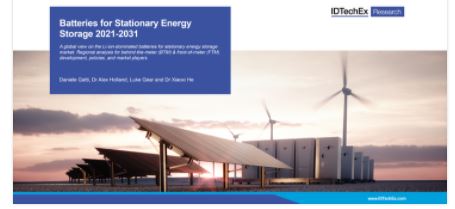
Electricity generation from renewable energies is growing daily and, to integrate their variable nature, energy storage systems are growing in parallel.
So says IDTechEx which has investigated the energy storage market’s evolution, forecasting its growth in the next 10 years in Batteries for Stationary Energy Storage 2021-2031.
It says green policies will drive the adoption of renewable energies and stationary energy storage, the latter dominated by the lithium-ion battery thanks to the EV and portable device markets.
Redox flow batteries (RDFs) are among other energy storage systems gaining traction.
New business models are also being developed, based on the management of battery systems, such us the virtual power plant (VPP) from the agglomeration of several battery units, and the adoption and implementation of vehicle-to-grid (V2G) approach, the report says.
“This approach exploits the battery electric vehicles (BEVs), which have a considerable battery capacity (100kWh compare to tens of kWh for home batteries), to provide ancillary services to the power grid.
“The stationary storage market is therefore evolving. An increasing number of companies are offering, besides battery storage systems, also solar storage, power purchase agreements (PPAs), and electricity tariffs.”
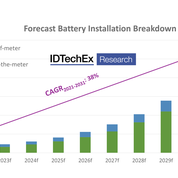
The evolving energy storage market is separated into Front-of-Meter (FTM) and Behind-the-Meter (BTM), the report says.
The FTM sector is related to the operation of the electricity infrastructure; therefore, batteries are employed to maintain a smooth and continuous flow of electricity to the consumers.
The BTM market instead is the customer side of the market; hence batteries are used by consumers to mainly decrease electricity costs.
The services provided by the batteries are similar most of the time, although on a different scale, IDTechEx says.
Its report aims to provide a clear picture of the status of the development of these two branches in the main countries adopting battery storage systems.
Other parameters like grid infrastructure and the energy sources adopted by countries (such as nuclear, coal, and lignite power plant) will also play an important role in the adoption of energy storage systems, the report adds
IDTechEx studied countries adopting energy storage systems, including the US, China, Japan, Australia and Germany, investigating the latest policies in terms of renewable energy and energy storage, as well as interviewing leader companies in the field of energy storage, to understand the market approach and the possible effect of COVID-19.
The result shows a similar but different scenario among the investigated countries.
The renewable energy target, with the current status of the grid infrastructure, in consideration of the different types of energy sources adopted by the country, defined a specific scenario for every country, IDTechEx says.
“As well as the differences, a clear point has been identified – the stationary storage market is only in its early stages, from both technical and policy aspects.”

Join the conversation