
Car sharing rises as Wellington reduces emissions
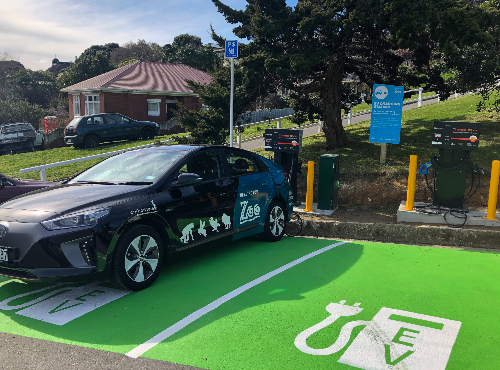
Wellington’s EV charger use has tripled in the past six months, and almost 11,000 Wellingtonians are now members of car share schemes.
But that’s just the start in reducing the capital city’s emissions with care share companies Mevo and Cityhop having 100 cars, some of which are hybrid or electric, and Wellington City Council providing around 30 car parks for these vehicles with more planned, Wellington mayor Andy Foster says.
“Electric car owners need confidence that there are places to recharge, and the council has supported the installation of 34 charging stations,” Foster adds.
A 2020 survey of Wellington car share members suggests that every car share vehicle replaces up to 11 private vehicles.
“This is such a positive part of our collective response to reducing transport emissions which make up around 35% of our footprint,” Foster says.
“Decarbonising our transport fleet is a critical part of reducing overall emissions.
“In Wellington, electric vehicles and car share services combine with New Zealand’s highest level of walking, cycling and public transport use, made possible by our compact city urban form.”
Wellington’s recently released City Greenhouse Gas Inventory shows during the past 20 years an overall decrease of 7%in net emissions, even though its population increased by 26% during that time.
“A reduction of 7% over two decades is a step in the right direction, especially considering the increases in GDP and population in the same time frame,” Foster says.
“We continue to be committed to climate action to achieve the city’s targets, a goal supported by the 92% of Wellingtonians surveyed who prioritised climate change action.”
The Wellington City Council declared a climate and ecological emergency about 18 months ago, putting protection of the environment and climate change action front and centre of its decision-making.
Its core business involves supporting low carbon transport, waste minimisation, native reforestation and protecting infrastructure from the threats caused by climate change.
Recent council initiatives include near completion of the cycling/walking path of the Great Harbour Way/Te Ara Tupua from Oriental Bay to the Miramar cutting, installation of six fast and 28 slow EV chargers around Wellington, prioritising sustainability in its procurement strategy and consulting on a climate-friendly spatial plan.
“While a reduction of 7% means we are heading in the right direction it’s nowhere near fast enough,” climate change portfolio lead councillor Tamatha Paul says.
“Hopefully now the Climate Change Commission has put out its draft advice, action by the council, residents and Wellington-based businesses and organisations will accelerate.”
Paul says the council’s long-term plan proposes an additional $27 million over 10 years to fully fund Te Atakura – First to Zero implementation plan to help the city achieve its net zero by 2050 goal.
“We also have significant funds earmarked for increasing our cycleway network, and building healthy streets and public transport options through Let’s Get Wellington Moving.”

Join the conversation