
Glenfiddich trucks tanked up on whisky waste
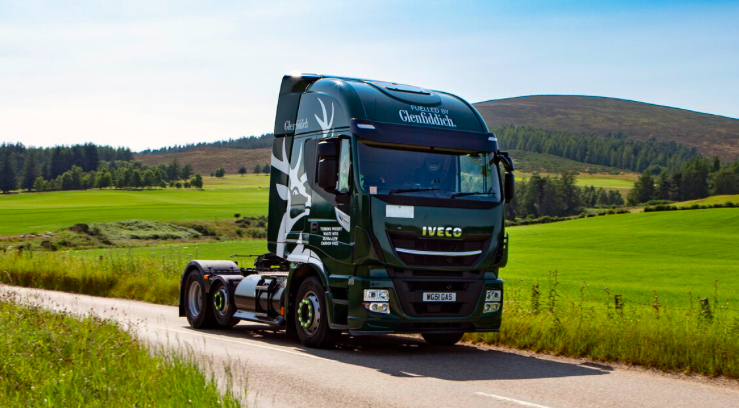

Scotch whisky maker Glenfiddich has launched a sustainable transport initiative that will make it the first global spirits brand to run its delivery fleet on green biogas made from distilling residues.
Using a unique technology developed by its parent company William Grant & Sons, the Glenfiddich distillery at Dufftown in north-eastern Scotland converts its production wastes and residues into an ultra-low carbon fuel (ULCF) gas that produces minimal carbon dioxide and other harmful emissions.
Fuelling stations have been installed at the distillery, and the biogas is now powering specially converted trucks that handle the transportation of the Glenfiddich spirit at all stages of its production at the Dufftown distillery through to bottling and packaging, a journey that covers four William Grant & Sons’ sites in central and western Scotland.

“Glenfiddich is appreciated around the world as a unique single malt whisky, which is the result of generations of pioneering craftsmanship and concern for the long-term sustainability of the spirit,” William Grant & Sons distilleries director Stuart Watts says.
“It has taken more than a decade for Glenfiddich to become the first distillery to process 100% of its waste residues on its own site, then to be the first to process those residues into biogas fuel to power its trucks, and finally to be the first to install a biogas truck fuelling station supplied by our on-site renewable energy facility.
“Across the entire production lifecycle, the biogas reduces carbon dioxide by over 95% and other harmful particulates and greenhouse gas emissions by up to 99% when compared to diesel and other fossil fuels.
“Each truck will displace up to 250 tonnes of CO2e annually, which has the same environmental benefit as planting up to 4000 trees every year – the equivalent of displacing natural gas, a fossil fuel, from 112 households.
“William Grant & Sons has been a pioneering distiller for more than 130 years, always exploring new processes and techniques to create sustainable benefits for our business and communities.
“We are proud of these renewable energy breakthroughs in our industry as we scale up the de-carbonising benefits of this closed-loop process across our entire transport fleet,” Watts says.



Join the conversation