
Jaguar I-Pace reaches new heights
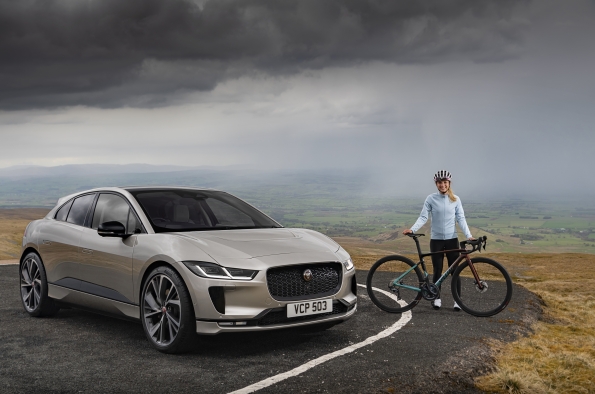
The electric Jaguar I-Pace has completed the ‘Everesting Challenge’ by climbing 8848m – the height of Mount Everest – on a single charge of its 90kWh battery.
The SUV completed 16.2 ascents of Britain’s highest surfaced road, Great Dun Fell in Cumbria, gaining 547m on each full climb.
Its regenerative braking developed from the Jaguar Racing Formula E team – which includes Kiwi driver Mitch Evans – recovered the equivalent to 93.3km of range under the challenge’s extreme conditions.
The Jaguar I-Pace was driven by Olympic and World champion cyclist Elinor Barker, with the popularity of repeatedly ascending a climb until the total elevation gain matches the height of Mt Everest booming among cyclists in the last year during the COVID-19 pandemic.
“I watched with fascination as cyclists took up the Everesting challenge during lock down – even as a professional rider, it’s a daunting feat of endurance, so I was happy to do it behind the wheel of the all-electric Jaguar I-Pace,” Barker says.
She completed 16.2 repeats of the 5.8km climb (a 11.6km loop in total) using the I-Pace’s regenerative braking technology to generate about 60% of additional available energy over the total 16 descents.
Having covered 199.6km in total, including a 2.87km drive to the start point on the fell, the I-Pace completed the challenge with 31% battery charge remaining – enough to drive for up to 128.7km more.
The I-Pace’s battery and cabin were preconditioned while charging using the Jaguar Remote App to optimise range and comfort – ideal for temperatures of less than 2°C at the summit.
The all-electric car has 470km range (WLTP), can add 63km and 127km range in 15 minutes on 50kW and 100kW DC fast chargers respectively and can reach 100km/h in 4.8 seconds.



Join the conversation