
Less EV charging beats fast charging
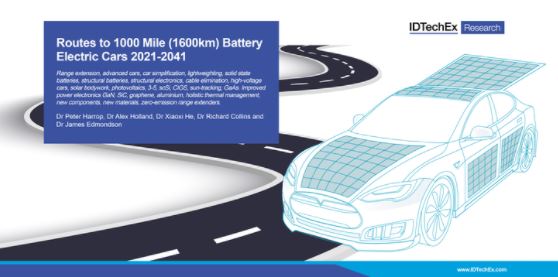
You’ll soon be able to buy an EV that only needs to charge one-third of the number of times, so you do that at home, at a hotel or supermarket perhaps once a month but never in the street.
Less charging beats fast charging any day, says the new IDTechEx report Routes to 1000 Mile (1600km) Battery Electric Cars 2021-2041.
Fast charging is all the talk now but doubling then trebling the range is seismic, says IDTechEx, adding the world solves its problems by eliminating infrastructure.
“Initially, it is primarily a matter of fitting larger batteries in simplified formats with better battery management software as they become affordable,” IDTechEx chief executive Raghu Das says. “However, taken together, further light weighting, simplification, new components, and all-over solar body will increase range almost as sharply,” he explains.
“No matter that the major impact of solid-state batteries will be after 2030 in our assessment – huge gains are coming before that.”
Das says many EVs do 515km today.
“Make that a relaxing 805km from many premium car makers in 2023 so the average driver charges about once a month,” he says.
“We predict a wide choice of cars with 1224km in 2031. This is a big deal because most people live in apartments in cities with no hope of their own charger. They can never again suffer the misery of street charging.
“With long-range, your car charges at destination delaying you not at all. Bear in mind that a car with barely adequate range can degrade to an embarrassing half the range with combinations of being hot, cold, old, full, driven hard, or towing and its resale value is poor. We calculate the detail.”
IDTechEx heavily discounts the promises of those involved, given their history of over-optimism, but it predicts strengthening demand for range.
Expect tripling of today’s range, it says. The enablers of this bring other delights. Light weighting improves acceleration and cost. Simplifications mean almost no maintenance.
Solar bodywork gives gentle users travel without ever using a charging station and the first get-you-home feature. If you drain the battery, you just wait and the body charges the car enough to get to a charger.
The 285-page report includes many other reasons for increasing maximum range and the existing and planned technologies to achieve it.
A chapter called Tesla Holistic Approach describes how it has achieved range by many small things such as cable elimination, more efficient motors, lowest drag factor, best batteries, and how it will go much further with massive simplification even beyond giant aluminium die castings.
Then come chapters on the technologies emerging with many new examples, citing Rivian, VW Group, universities, and other innovators.
Solar cars with increased range are covered too with major moves by Hyundai, Tesla, Toyota, VW Group, and other giants plus start-ups selling solar vehicles, such as Sono Motors getting more than 13,000 orders by emphasising all-over solar.
The many solar formats and chemistries such as film-wrap or load bearing are critically appraised and the roadmaps and benefits are compared now and in the future, even unfolding, sun tracking, and super-efficient versions.
Another chapter studies batteries and supercapacitors’ increasing range.



Join the conversation