
National launches ‘ambitious’ EV plan
EVs will be exempt from fringe benefit tax (FBT) until 2025 to encourage fleet uptake, and a road user charge (RUC) exemption will be extended to at least 2023 under a National government.
National’s EV policy, launched at Auckland City Electric Vehicles in Auckland on September 11, also includes setting a target of 80,000 EVs on the road by 2023 (four times the current level), allowing EVs to use bus lanes and high-occupancy lanes, and aims to have a third of the government light vehicle fleet in EVs by 2023.
The party’s EV package estimates the fiscal impact at $93 million over four years. This includes $55m over four years in lower revenue from exempting EVs from FBT and $38m over four years in electrifying the Government fleet.
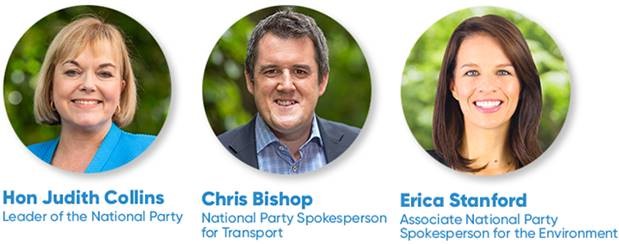
A National Government will make EVs cheaper and reduce transport emissions through its “ambitious” EV plan, says National Party leader Judith Collins in announcing the policy alongside National’s transport spokesperson Chris Bishop and associate environment spokesperson Erica Stanford.
“We’re committed to addressing the issue of our transport emissions in a practical and effective way,” Collins says.
“This ambitious plan will make EVs cheaper and easier to own without unfairly taxing Kiwis.
“We believe the future of transport in New Zealand will be zero emissions. Our ambitious and comprehensive plan will encourage the purchase of EVs, create a thriving secondhand EV market, support sustainable transport infrastructure, and lower carbon emissions in New Zealand’s transport sector.”
Bishop says transport emissions are the largest driver of increasing greenhouse gas emissions in New Zealand, having doubled since 1990.
“National has a bold plan to address this,” he says.
“Labour has failed to deliver a single new policy to increase EV uptake. Their abandoned car tax actually slowed EV sales and, if implemented, would have punished those who could least afford it.
“Exempting EVs from fringe benefit tax will significantly bolster the secondhand market by giving Kiwis access to New Zealand-new, longer range, late model EVs.”
Stanford says National’s policy package is practical, supported by the sector and will deliver immediate positive benefits.
National believes more can be done to allow the shift to fully electric, plug-in hybrid (PHEV) and hydrogen vehicles (FCEVs) sooner, its two-page EV plan states, possibly including extending the RUC break for six years rather than three.
New Zealand has more than 22,000 EVs, representing about 0.6% of the light passenger fleet, but that growth is slow and has been impacted by the Labour-led government’s Clean Car scheme, particularly its “feebate” proposal, it adds.
“The policy was poorly targeted with most of the money going to drivers of smaller petrol cars rather than EVs.”
The EV plan says EV sales growth slowed while buyers “waited for a rebate that would never materialise”.
A new EV licence plate will be introduced by National for ease of identification and to allow EV users to access bus lanes and high-occupancy vehicle lanes, which National says it will implement immediately on state highways and work with councils to have in cities if elected after October 17.

Join the conversation (1)
Unfortunately still no limit on CO2 emissions for new vehicles! So we will still end up with cheap rubbish that they can’t sell elsewhere.