
Tesla log-hauling pilot could be part of $149b market opportunity
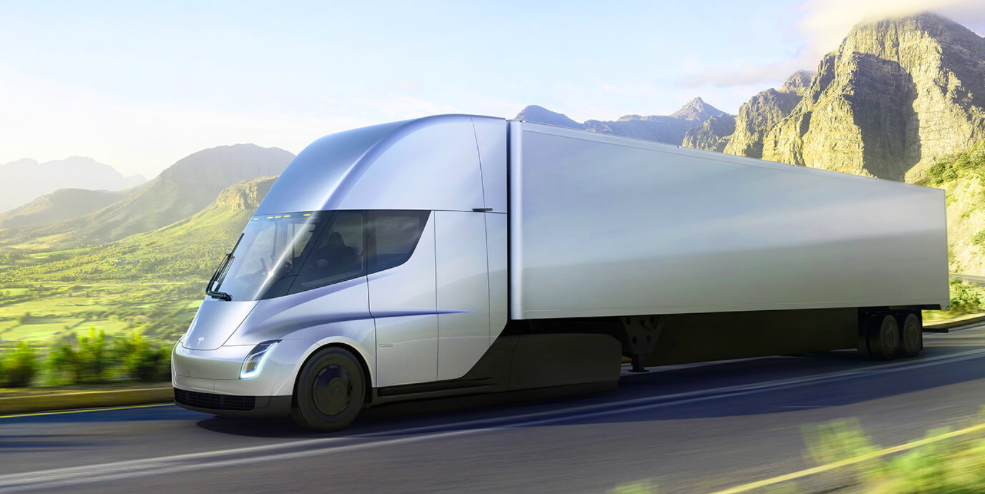

The electric vehicle market in construction, agriculture and mining is expected to reach $149 billion by 2030 and the Tesla Semi truck is looking to take a slice of that, according to the latest IDTechEx report.
The forestry sector innovates with electric vehicles using supercapacitors providing huge surges of energy to rip trees out of the ground. Could they next capture the energy of the tree falling? That’s the question pitched by the IDTechEx report.
Furthermore, in an open-pit mine of the future, monster trucks carrying ore round and up the sides could be battery electric: the trucks go down empty, but 30 minutes of regenerative braking saves tens of kWh of electricity that would otherwise be needed at a charging station, reducing truck availability, the Electric Vehicles in Construction, Agriculture and Mining 2020-2030 report says.
Tesla Semi pilot
The latest forestry example is carrying trees down from the mountains of Canada. Tesla Semi electric trucks are going to power a log-hauling pilot programme in Canada that is aspiring to be the first zero-emission log trucking operation.
Mosaic Forest Management recently announced its partnership with local Vancouver Island service provider, EcoWest Driven, to introduce several Tesla Semi trucks into log hauling.
The British Columbia forest sector already plays a significant role in addressing climate change. Electrifying the fleet is a good approach in the region where over 90% of power is generated from clean hydroelectric sources, the report says.
Mosaic says that there is currently no log truck that can handle the conditions in which they work on Vancouver Island where the logs are carried downhill involving excessive braking for long periods of time. Mosaic’s vice-president and chief forester Domenico Ianndinardo says the Tesla Semi pilot programme will be a first for the logging industry.
“To our knowledge, there’s no one in the world hauling logs with fully electric trucks in the mountainous terrain that we have here, so this would be a global first for fully electrified full log haul trucks,” he told CHEK News. If the pilot programme proves successful, Mosaic would electrify its fleet of 300 logging trucks as part of its efforts to become carbon neutral by 2035.
Ianndinardo noted that electric trucks like the Tesla Semi are actually an excellent fit for the logging industry, especially in Vancouver Island, where much of the timber is located in higher elevations. This means that a significant part of the energy consumed by the trucks when they go up to the mountains could be replenished as they travel back, thanks to regenerative braking.
“As they come down the hill loaded, they’re able to regenerate energy and put that back into their batteries so in this cycle going up the hill empty and coming down the hill loaded they can generate their own battery supply on a daily basis,” Ianndinardo says.
Mosaic Forest Management is announcing its partnership with local Vancouver Island service provider, EcoWest Driven, to introduce several Tesla Semi trucks into log hauling. For the modest top-up, EcoWest Driven is going to build a charging station with 45 commercial chargers and a service garage at their Angel Road property in Parksville.
“Although some companies are developing fuel cell alternatives to the Tesla Semi, they have more to go wrong, need expensive hydrogen infrastructure, and have limited capability for extended regenerative braking,” the report says.
IDTechEx chief executive of analysts Raghu Das says there is a significant market for downhill EV trucks for mountainside forestry and mining.
“Battery electric has no rival here. Indeed, the same idea applies with huge load-haul-dump trucks in Canadian deep mines that sometimes have to take ore downhill returning empty.
“Canada commissioned the world’s first unmanned deep mine last year thanks to electrification. You can even see the same principle in successful trials of descending battery electric aircraft reversing their propellers to generate electricity and regenerative braking of aircraft on landing.
“Whether land, sea, or air, battery electric vehicles are winning for a host of reasons like these, their range and payback being improved in many ways not so feasible with alternatives,” Das says.
“Snapshot appraisals of today’s situation can be misleading. We calculate many routes to battery electric vehicles with 1000 miles (1609km) range even on the flat.”

Join the conversation