
Watch: Can a plug-in hybrid really be cheaper to run than an EV?
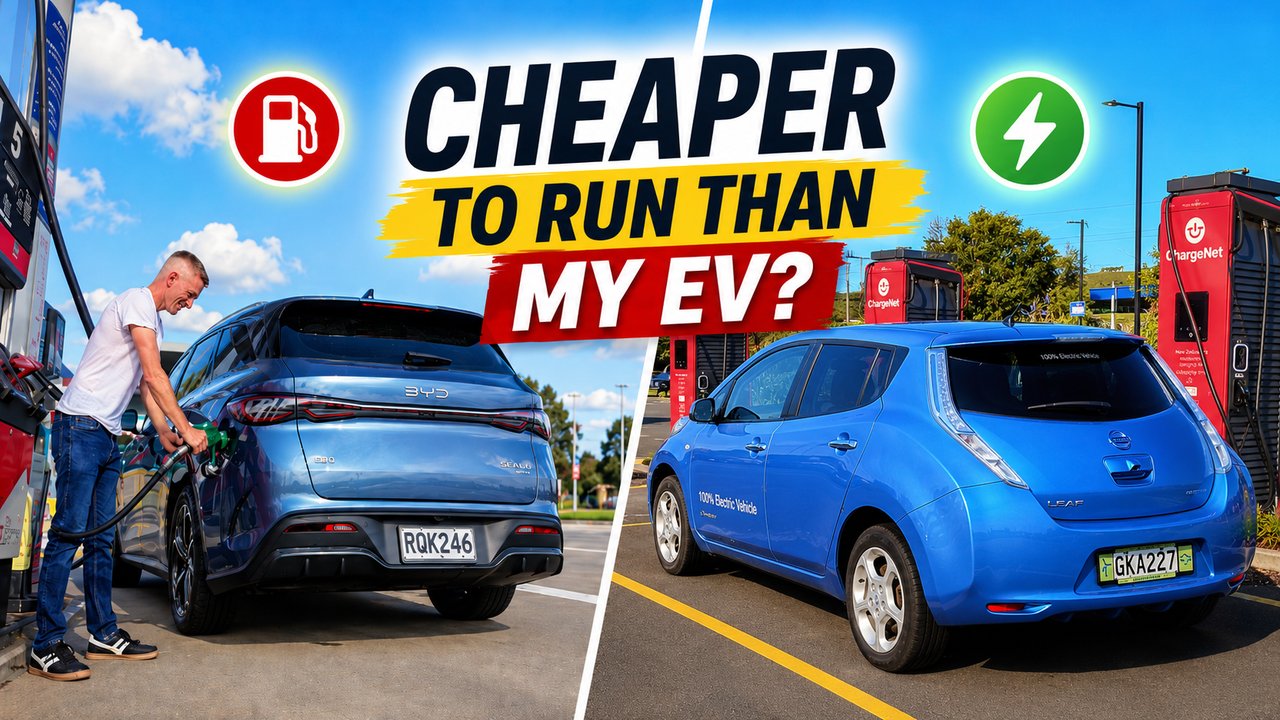
Group EV editor Gavin Shoebridge puts the BYD Seal 6 plug-in hybrid wagon to a real-world running cost test in his first video review for EVs and Beyond, and the result surprises even him.
“This thing’s actually cheaper to drive than an electric car. This infuriates me, but it’s true,” Shoebridge says in the video.
The test sees Shoebridge drive the Seal 6 200km from his home in Te Kūiti to Auckland on a full tank and full charge, without stopping to plug in, then compare the total cost against the same journey in his own 2011 Nissan Leaf.
The Seal 6 uses five litres of petrol over the trip, equating to 2.5 litres per 100km, at a cost of $15.28. The same run in the Leaf requires two public charging stops totalling around $25.
Road user charges widen the gap further. Battery electric vehicles pay $76 per 1000km, while plug-in hybrids currently pay roughly half that. Shoebridge calculates $15.20 in RUC for the Leaf against $7.60 for the Seal 6.
The final tally: $40.20 for the electric Leaf, $22.89 for the plug-in hybrid BYD.
“Somehow, using my terrible maths, this is cheaper to drive than my electric car,” he says.
The Seal 6 arrives in New Zealand in a single, fully loaded Premium specification priced at $54,990 plus on-road costs. Its 19kWh battery delivers a claimed 125km of electric-only range, well beyond the 40km or so typical of earlier plug-in hybrids, while BYD claims a combined range of 1300km from one tank and one charge.
Power comes from a 160kW electric motor with a 1.5-litre petrol engine producing 60kW, which works primarily as a generator, though it can drive the front wheels directly at cruising speeds. The 0-100km/h sprint takes 8.1 seconds.
Shoebridge praises the wagon’s 670-litre boot, comfortable ride, sharp camera and display tech, and the vehicle-to-load adapter included in the price, which he demonstrates by cooking potatoes from the charging port. Criticisms include limited rear headroom, a 750kg towing capacity and DC fast charging capped at 27kW, meaning a 20 to 80 per cent top-up takes around 30 minutes.
“While my heart lies in pure electric vehicles, this does still serve a purpose,” he says. “Two and a half litres per 100km I got out of it in the real world. That’s low emission and low running cost, and I’m saying this as a diehard EV nut.”
Join the conversation